We Measured a Wardrobe Ourselves. Here's What the Spec Sheet Hides.
Who this is for
We put a tape measure to this wardrobe. Not someone else's numbers. Ours. Front. Side. Back. Interior. Every panel. Every gap. The kind of measurement you'd take if you were buying it yourself and didn't trust the listing.
446mm says the spec. That's the depth — from the front face of the door to the rear edge of the back panel.
We measured the interior cavity. 446mm. Same number. The tape matched the spec sheet. That doesn't happen often. Most wardrobes lose 30-50mm between the exterior measurement and the space your clothes actually get. This one doesn't.
This is the Elegant 3-Door Oak Wardrobe. Natural oak finish. Three doors. Two drawers. S$120 all-in — delivery and installation included.
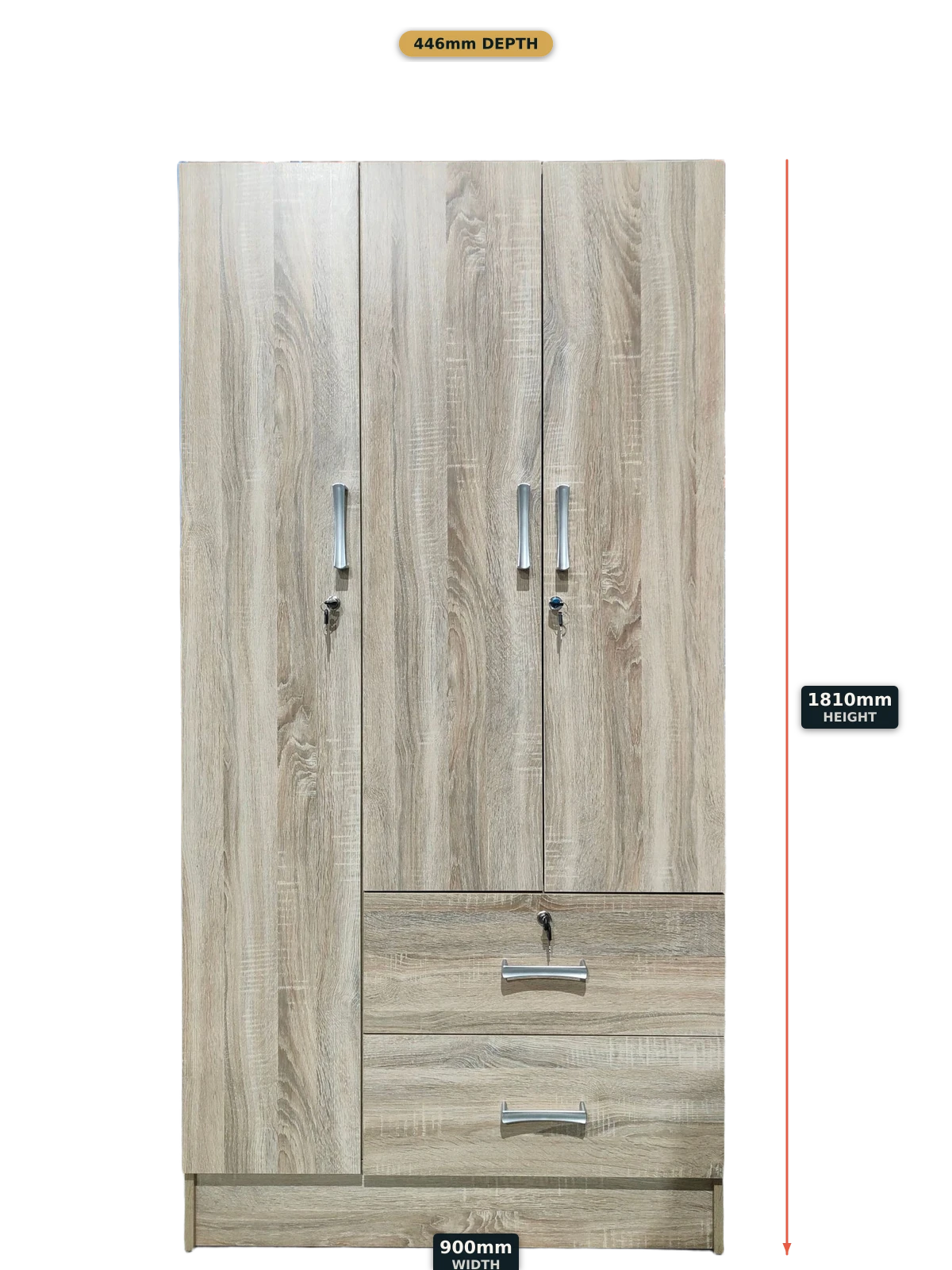
But the thing about this piece isn't the price. It's what happens when you measure it yourself.
What "quality" means when nobody defines it
Here's a question most furniture buyers never ask: what standard defines whether a wardrobe is well-built?
In Singapore, there is no mandatory furniture quality standard for residential products. None. A S$60 wardrobe from an online marketplace and a S$600 wardrobe from a showroom are bound by exactly the same regulatory requirements — which is to say, essentially none.
That changes when you move to institutional procurement. BCA Approved Product classification. BIFMA X5.5 cyclic load standards. EN 1728:2012 durability requirements. Fire safety ratings. Structural integrity certification. These aren't marketing terms — they're procurement prerequisites for schools, hospitals, and government contracts.
For residential buyers, you're left with two things to evaluate quality: whatever the retailer chooses to tell you, and whatever you can verify with your own eyes when the piece arrives.
We think the second one matters more.
So we measured this wardrobe ourselves. Every number in this article came from a tape measure held against the actual unit, not from a spec sheet copied from a manufacturer's catalogue.
446mm in the spec. 446mm on the tape.
We put a tape measure inside this wardrobe. The interior cavity measured 446mm from the inside face of the back panel to the inside face of the closed door. The spec sheet says 446mm. The tape says 446mm. No gap. No missing millimetres. No creative measurement.
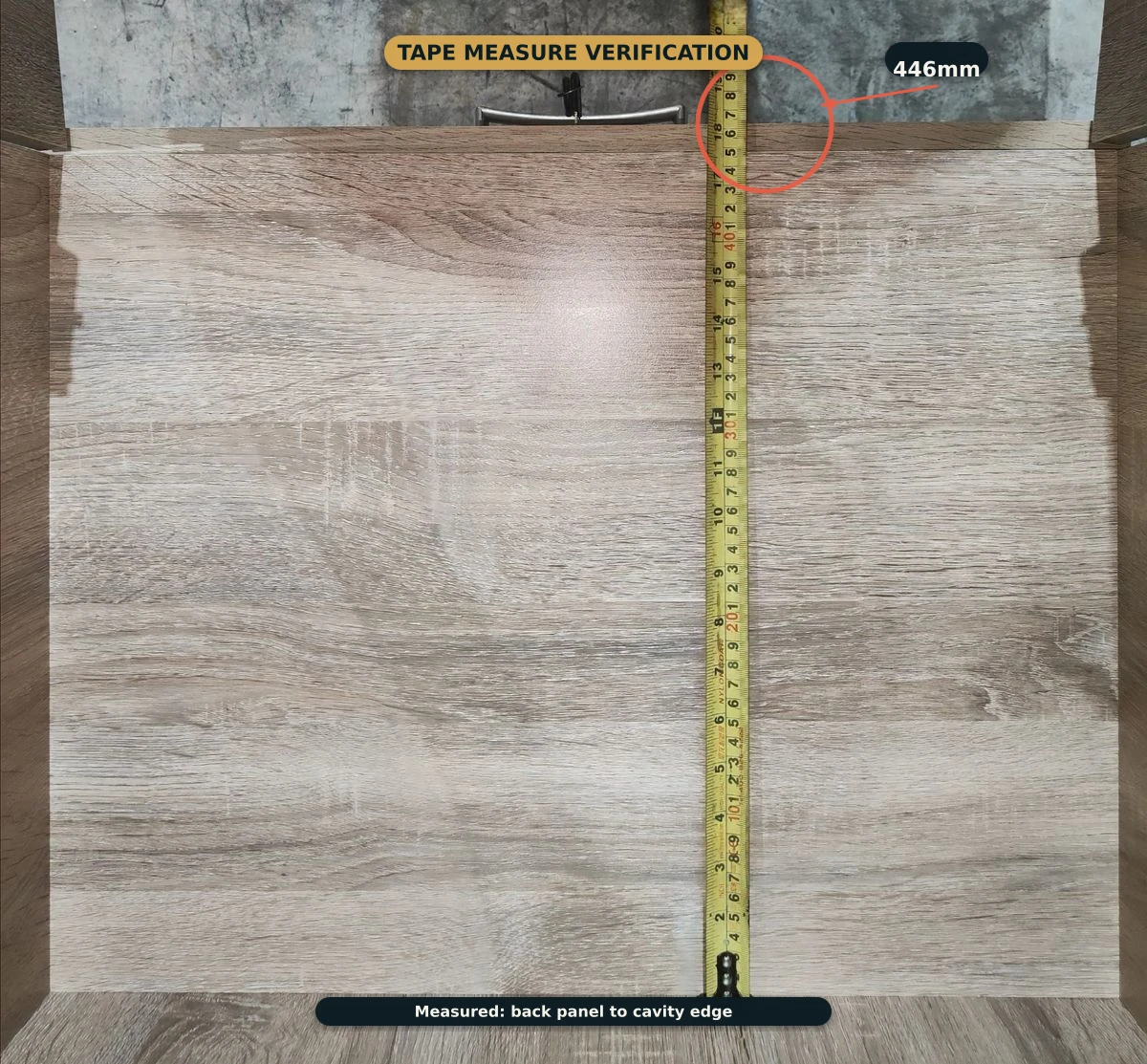
This isn't normal.
Most wardrobes sold in Singapore list an exterior depth of around 400mm. That's the outside measurement — from the outer face of the door to the rear edge. The interior cavity is typically 350-370mm after you account for door thickness, back panel setback, and hinge projection. A standard 440mm wooden hanger does not fit in a 350mm space. You'd need to angle it. Or not use that part of the wardrobe for hanging at all.
This wardrobe gives you 446mm of usable cavity depth. A 440mm hanger fits front-to-back with clearance. That's not an accident. It's a construction choice that prioritises the space your clothes actually occupy over the space the cabinet occupies in the room.
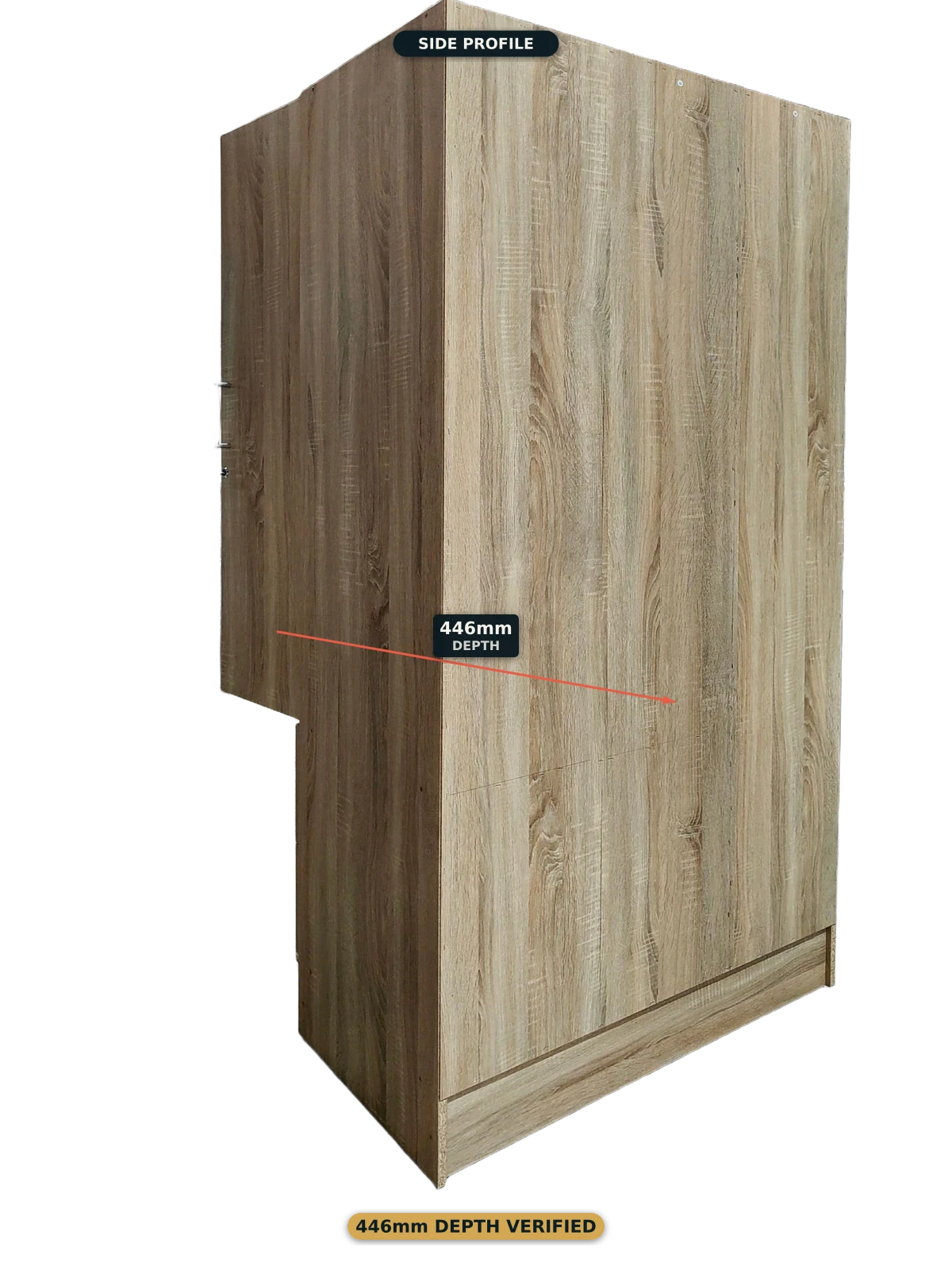
The door thickness is within the frame, not eating into the cavity. These doors are solid wood-frame with an oak finish, approximately 20mm thick. On most wardrobes, that 20mm reduces your interior depth. On this one, the frame extends to accommodate it — the doors close within the exterior depth, not inside it.
The hinges are inset, not projecting. Each door has three hinges. The hinge body projects into the frame, not into the cavity. At the hinge line, you still get the full 446mm of usable depth between the back panel and the door face.
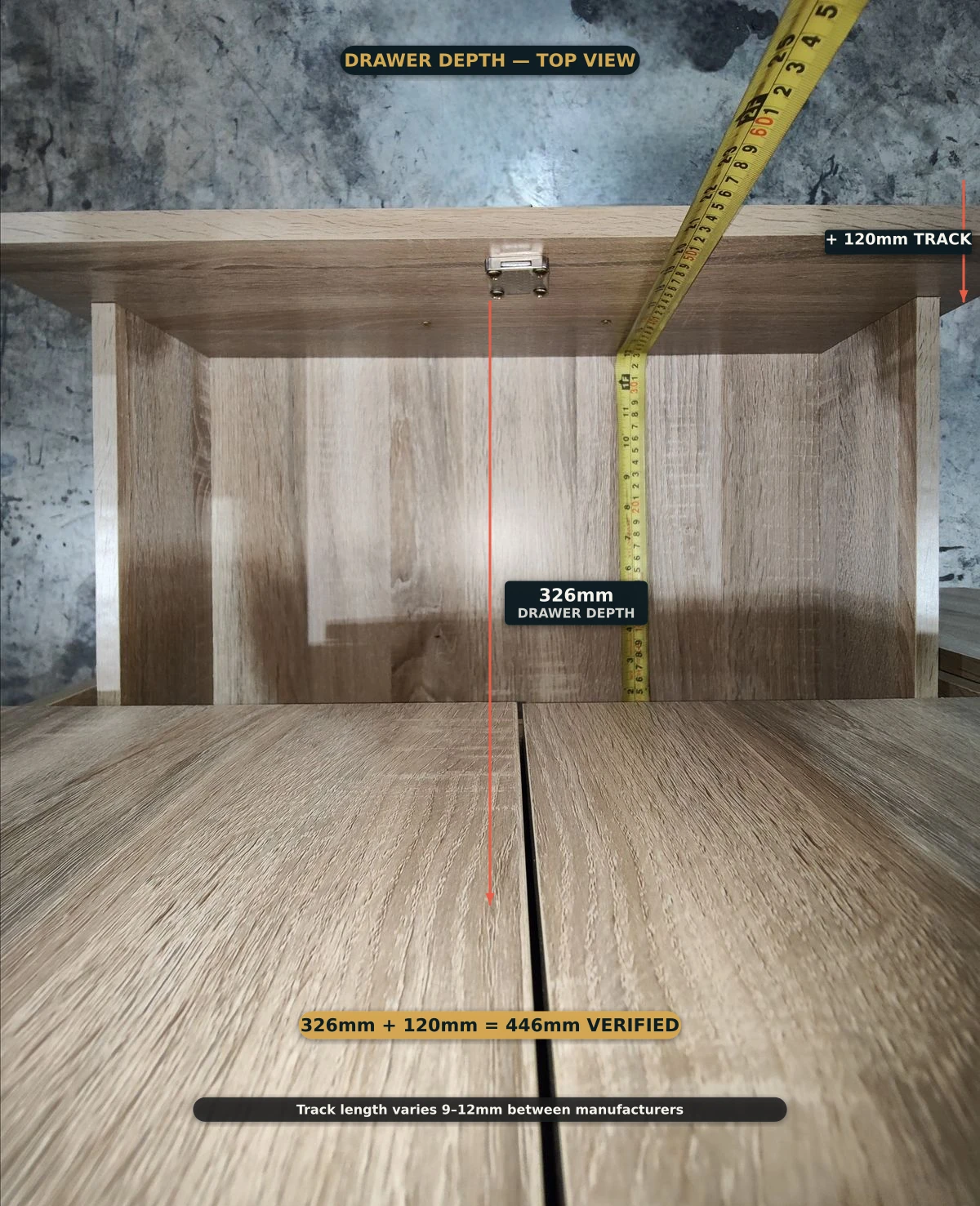
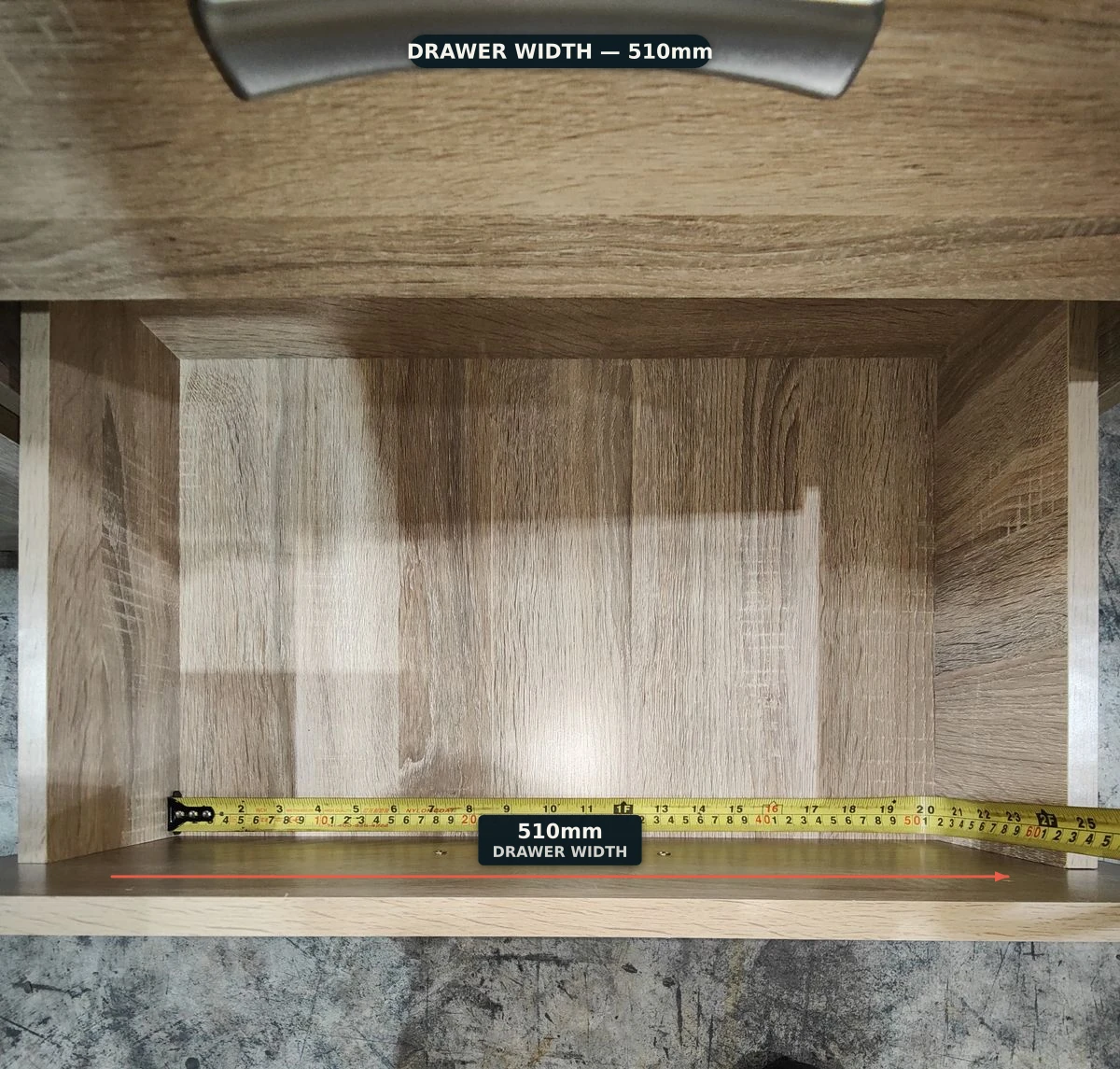
The drawers confirm it. We measured the interior drawer depth at 326mm. The standard drawer track length is 120mm. Add them together: 326mm + 120mm = 446mm. The drawer cavity depth matches the spec. This matters because drawer track length varies between manufacturers — from 9mm to 12mm longer or shorter — and that variance directly affects volumetric capacity. A 326mm drawer with a 120mm track gives you full-depth access. Swap the track for a shorter one and you lose storage volume inside the drawer. The track is part of the measurement, not an afterthought.
The interior view confirms it. Shelves, hanging rod, drawers — all within the 446mm envelope.
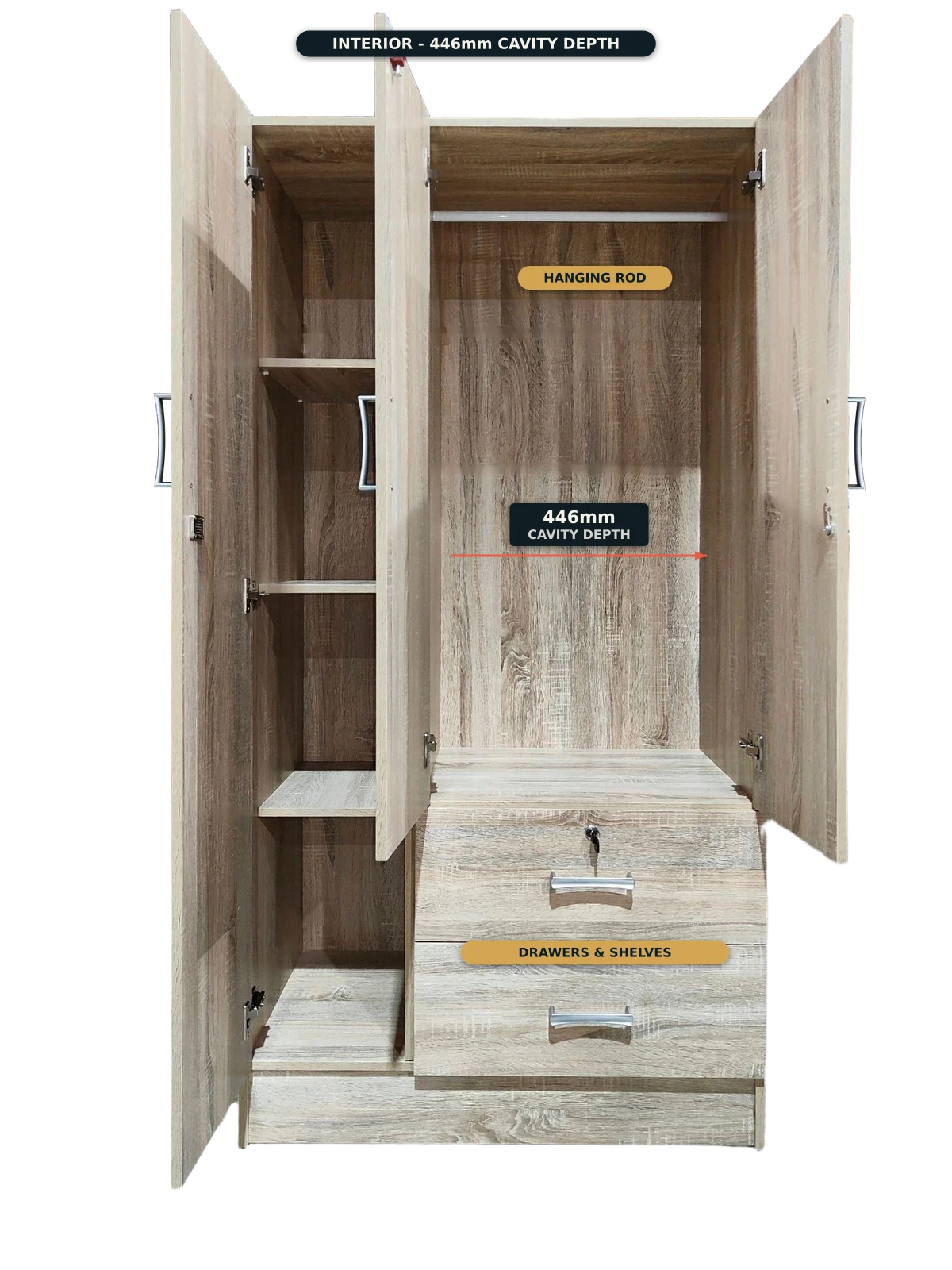
The construction logic: this wardrobe was designed so the spec number (446mm) matches the measurement you'd take yourself with a tape. No discrepancy. No explanation required. What's written is what's inside.
We call this white-hand tactics. Product disclosure at the point of measurement. Transparency as a construction principle, not a marketing afterthought. Authenticity verified by the buyer's own tape measure, not by the seller's creative copy. Consumer trust protected because the number on the listing is the number on the tape.
Most retailers don't do this because most wardrobes can't survive this test. A 400mm exterior depth that yields 360mm of cavity space fails the moment someone measures. The spec becomes a lie of omission — technically accurate for the exterior, misleading for the interior where it matters.
This wardrobe passes. 446mm exterior. 446mm cavity. The tape confirms it.
How to verify this yourself — on any wardrobe
This isn't just about this wardrobe. Nearly every wardrobe sold in Singapore has an interior depth that's 30-50mm less than its exterior spec. A 400mm exterior yields 350-370mm of cavity. That's the norm. This one is the exception — the cavity matches the spec. What's different is the construction, and whether anyone tells you the difference.
Here's what to check on any wardrobe before you buy — and what to look for when it arrives.
What the retailer should tell you (but usually doesn't)
-
Interior depth, not just exterior. Ask: "What is the usable interior depth from the inside face of the back panel to the inside face of the closed door?" Most wardrobes lose 30-50mm between the spec and the tape. This one doesn't — 446mm exterior, 446mm cavity. If they can't confirm the interior measurement, assume you lose 30-50mm.
-
Back panel material and thickness. A 3mm fibreboard back panel warps under shelf load and provides almost no structural rigidity. This one is fully laminated on both surfaces — melamine thermally fused to the substrate, not a thin foil glued on. No exposed particleboard. Full lamination means the panel resists ambient moisture absorption and holds the wardrobe's structural geometry under load. The back panel prevents the entire wardrobe from racking sideways when shelves are filled with folded clothes.
-
Door hinge type and count. Three hinges per door means the door is supported at three points along its height. Two hinges means the middle of the door can bow outward over time, especially in Singapore humidity. More hinges distribute load better and keep doors aligned.
-
Edge banding on all exposed surfaces. Edge banding isn't trim — it's moisture ingress prevention. In 70-85% humidity, unfinished particleboard edges absorb ambient moisture and swell within months. Every cut edge should be sealed. On this wardrobe, they are — including the bottom edge of the bottom shelf, where a mop or wet shoes create the highest moisture contact.
-
Shelf adjustment range. Fixed shelves waste vertical space. Adjustable shelves let you reconfigure as your storage needs change — boots one season, folded linens the next. The pin holes should be cleanly drilled, not ragged.
What you check on delivery
When our team delivers and assembles, here's what to verify before they leave:
Door alignment. Open and close all three doors. They should swing smoothly, no scraping at the top or bottom. Gaps between doors should be even — 2-3mm. If one door overlaps the adjacent door, the hinges need adjustment.
Shelf stability. Each shelf should sit level on all four shelf pins, no tilt, no wobble. Push down with moderate pressure. No deflection.
Hanging rod security. The rod should not rotate or slide. Push down lightly — it should bear your weight without flexing.
Back panel flushness. No bowing, no gaps at the edges. The back panel should be firmly attached to the frame along all four sides. If it's loose, the structural integrity is compromised.
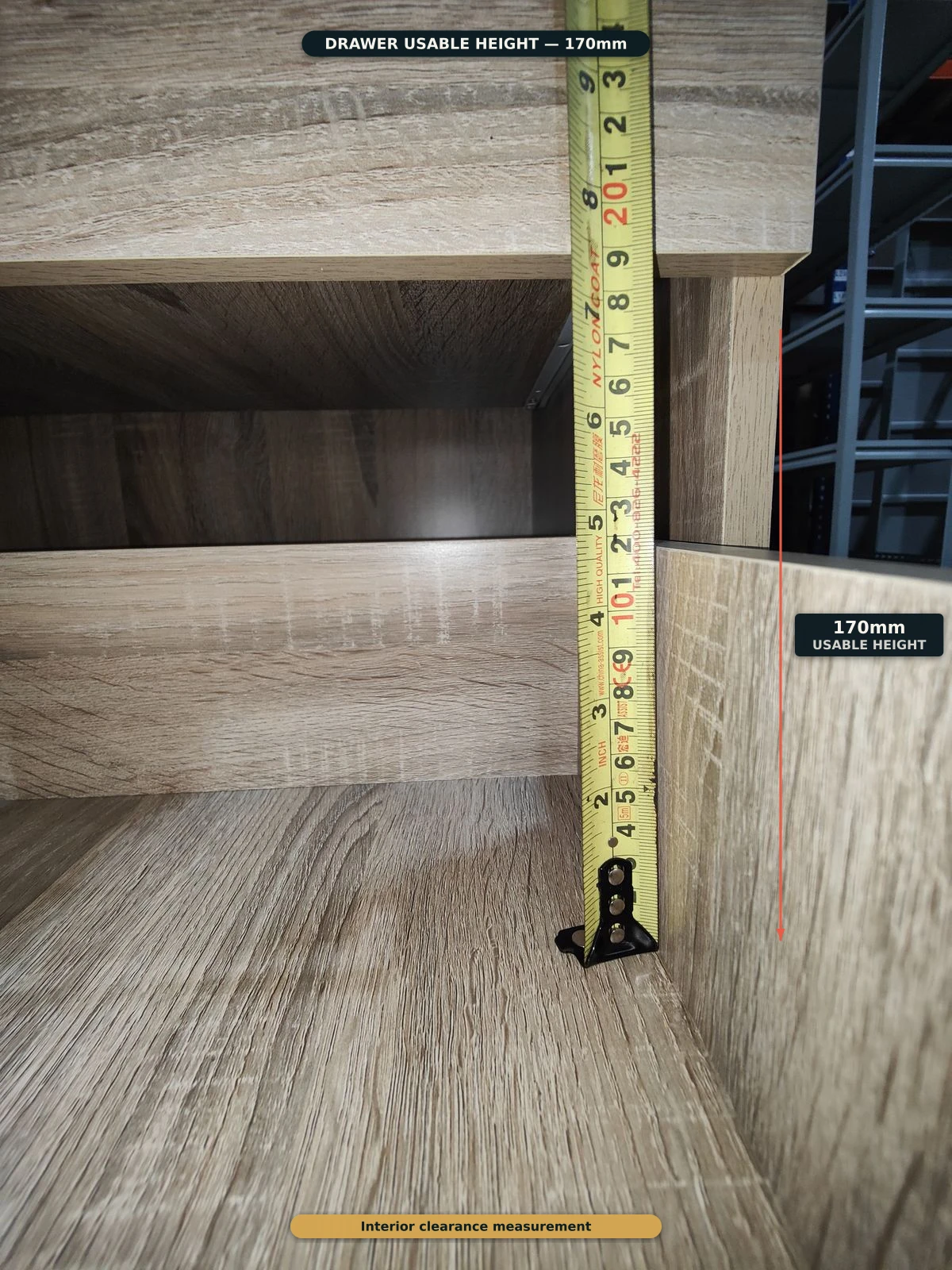
Drawer clearance. The centre drawers should extend fully without scraping the door frame. If a drawer catches, the door hinge positions have shifted.
What this means in a Singapore home
HDB bedrooms are not generous. A 900mm-wide wardrobe against one wall, a queen bed against the opposite wall. You need at least 500mm clearance between the wardrobe face and the bed to open the doors without hitting the mattress. Measure that before you buy anything — wardrobe, bed, or both.
Standard HDB ceiling height is 2,600mm. This wardrobe at 1,810mm leaves a 790mm gap above it — enough for storage boxes, decorative items, or just visual breathing room. A taller wardrobe that reaches 2,200mm or more leaves only 400mm and risks blocking air circulation. BCA ventilation requirements exist for a reason — furniture height isn't only aesthetic; it affects airflow in a room.
And here's something that surprises first-time buyers: a 446mm-deep wardrobe is actually practical for HDB bedrooms. It doesn't protrude into walkways the way a 550mm-deep wardrobe does. And unlike most wardrobes at this depth class, the 446mm cavity means a standard 440mm wooden hanger fits front-to-back. No angling. No squeezing. Hang it straight, close the door, done.
That's not normal for this price point. Most wardrobes in the 400mm exterior depth category have 350-370mm of usable cavity. Hangers don't fit. Closets become shelf stations with a hanging rod that's decorative. This one was built so the rod actually works.
The shelf space works too — at 446mm interior depth, folded shirts, jeans, and sweaters stack cleanly. Deep enough for organised stacks, shallow enough to reach the back without leaning in.
The dimensions — measured by us
Every number in this article came from a tape measure held against the actual unit. Not from a spec sheet. Not from a manufacturer's catalogue. We measured front, side, back, and interior ourselves.
If you're buying furniture online without seeing a unit in person, at minimum ask for photos that show interior depth, back panel construction, and hinge attachment. If the seller can't provide those, ask yourself what they don't want you to see.
The price
This wardrobe was S$177.56 at retail. It's now S$120 all-in — delivery, assembly, and installation included. No surcharge for staircases. No hidden add-ons at checkout. The price you see is the price you pay.
Why S$120? We held backup inventory for active supply contracts. Those contracts have concluded. The backup units that weren't needed are now clearance. We clear the warehouse space. You get the wardrobe at nearly 40% off. Both sides win.
Before you buy — three checks:
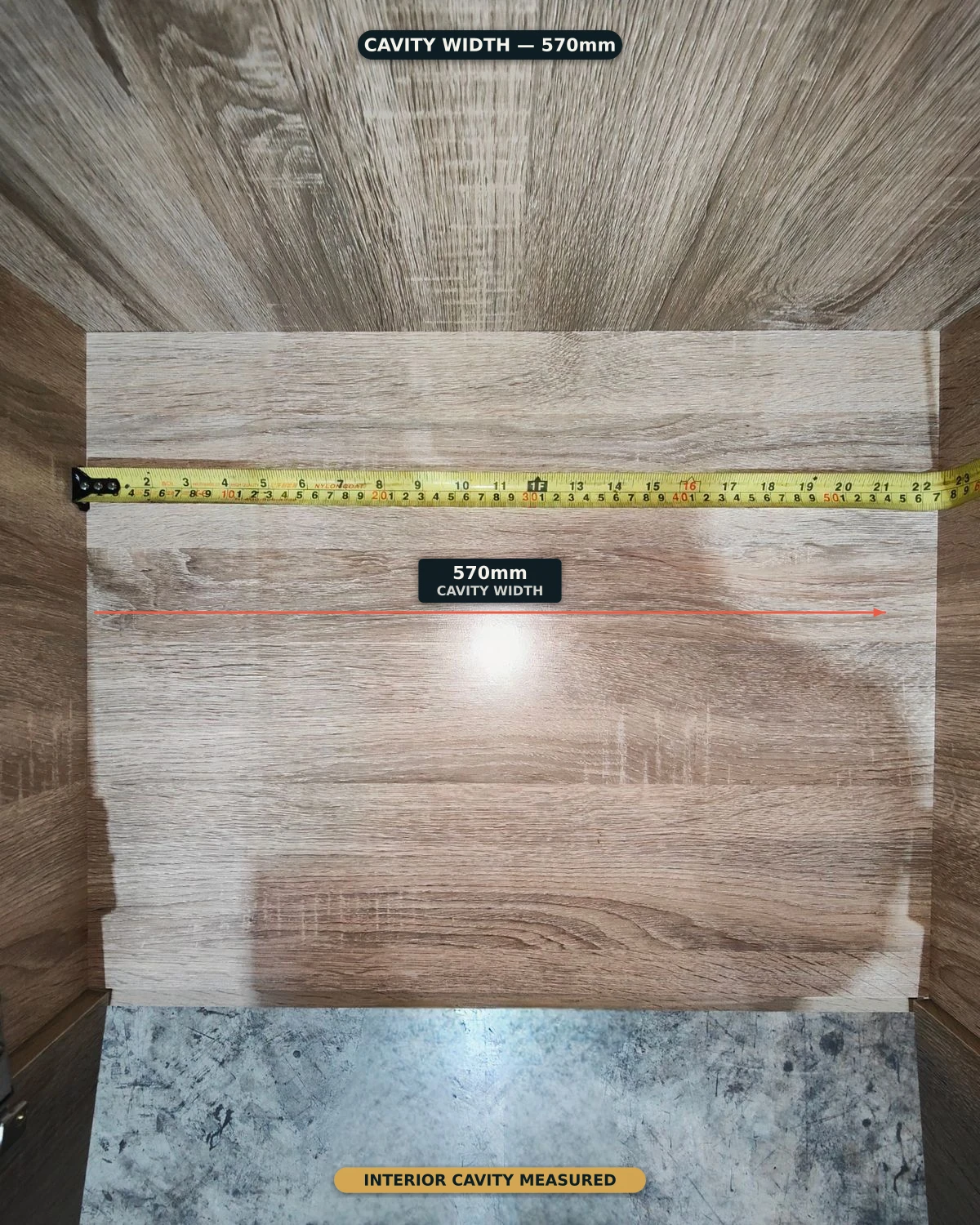
- Measure your wall. 900mm wide x 446mm deep. Ensure 500mm+ clearance in front for door swing.
- Bring a hanger. A standard 440mm wooden hanger fits in the 446mm cavity. Try it yourself on delivery.
- Inspect on delivery. Our team handles assembly. Before they leave: doors flush, shelves level, back panel secure, drawers clear.
Questions about dimensions or quality? Email us: km-shawn@outlook.com
Related reading: Solid Wood Doors at S$75. Here's What That Actually Means in Singapore. — how solid wood construction handles Singapore's humidity cycles in entryway furniture.
Want to see all clearance? /clearance
Skip reading if you must (we like you understand) — quick clicks are fine, no need to fuss — but do not miss completing your purchase. Once it's gone, it's gone.
Related investigations
Further reading from the catalog
Solid Wood Doors at S$75. Here's What That Actually Means in Singapore.
Most shoe cabinets under S$100 are melamine-faced particleboard with screw-on handles and sharp corners. You know the type — flat-pack, flat-pack, flat-pack....
Read article →You Don't Need a Bigger Shoe Cabinet. You Need Another One.
Every HDB household hits the same wall: the shoe cabinet is full. Six months after moving in, someone's work boots are permanently parked beside it. Another...
Read article →200 Students, 40 Chairs, 3 Academic Years: What School Furniture Contracts Reveal
I once delivered 40 training chairs to a secondary school in Tampines. Three months later the facilities manager called — not because anything broke, but...
Read article →Found an inaccuracy?